
4x4 Matrix Calculator
Four-by-four matrices are where hand calculation gets tedious. Enter a matrix — whole numbers, decimals or fractions like 1/3 — and this calculator gives the determinant with cofactor-expansion steps, the exact inverse as fractions, the rank, trace and transpose, eigenvalues (including complex ones), products and sums with a second matrix, and the solution of a system Ax = b.
- Free to use
- No sign-up
- Runs in your browser

4×4 matrix calculator
4×4 Matrix Worksheets
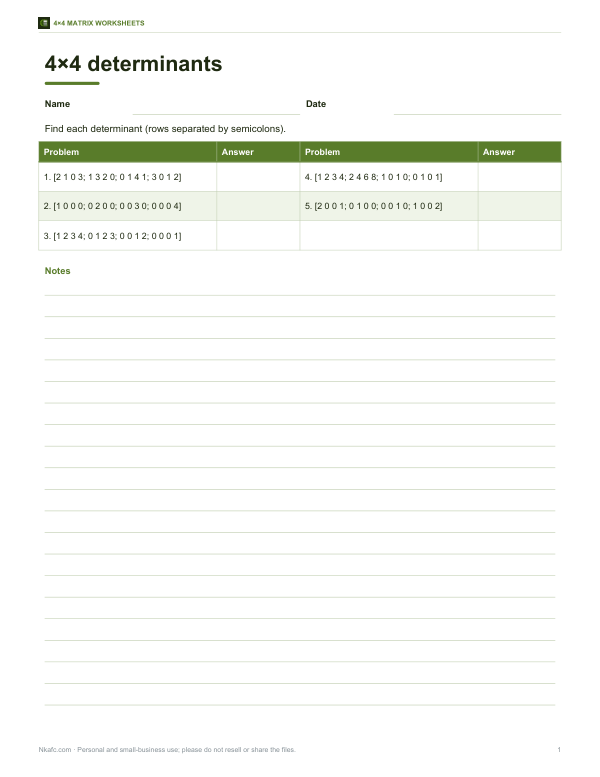
4×4 determinant and inverse practice with worked answers, a cofactor expansion template and a matrix operations reference sheet.
- Determinant practice (PDF, DOCX)
- Cofactor template (PDF/DOCX)
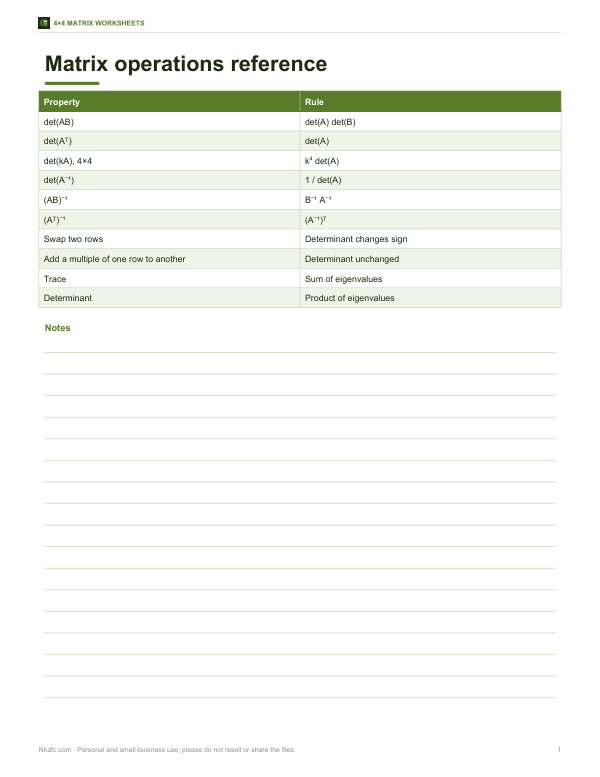
- Reference sheet (PDF/XLSX)
Formats: PDF, DOCX, XLSX. Instant download after payment (link valid 72 hours, up to 5 downloads). AI-assisted: the templates were drafted with AI help and reviewed and laid out before publishing.
$5.00 USD, one-time 3 files · about $1.67 each
- Instant download
- 7-day refund
- Secure checkout by Stripe
7-day money-back guarantee. Full refund within 7 days of purchase, even after you download.
Full refund within 7 days — see the refund policy and license.
Free printables
Single sheets you can print right now, no sign-up. The full pack adds every sheet in one download plus the editable files.
What the calculator does
| Operation | Result |
|---|---|
| Determinant | Exact value, with cofactor expansion along the first row |
| Inverse | Exact fractions by Gauss–Jordan elimination; reports when A is singular |
| Rank, trace, transpose | Plus the reduced row echelon form |
| Eigenvalues | Real and complex eigenvalues from the characteristic polynomial |
| A × B, A + B, A − B | Exact results |
| Solve Ax = b | Unique solution, or a report of no / infinitely many solutions |
Entries can be integers, decimals (0.25) or fractions (3/4). Arithmetic is exact, so answers like 7/51 come out as fractions rather than rounded decimals.
The determinant of a 4×4 matrix
Expanding along the first row, det(A) = a₁₁M₁₁ − a₁₂M₁₂ + a₁₃M₁₃ − a₁₄M₁₄, where each M₁ⱼ is the determinant of the 3×3 matrix left after deleting row 1 and column j. Each 3×3 determinant expands the same way into 2×2 determinants. That is 24 products in total, which is why a calculator (or row reduction) is welcome. A zero in the first row removes a whole term — choose the row or column with the most zeros when working by hand.
Worked example
For the example matrix A = [[2, 1, 0, 3], [1, 3, 2, 0], [0, 1, 4, 1], [3, 0, 1, 2]], the first-row minors are M₁₁ = 17, M₁₂ = 13, M₁₃ = 11 and M₁₄ = 31. The expansion gives det(A) = 2(17) − 1(13) + 0(11) − 3(31) = 34 − 13 + 0 − 93 = −72. Because the determinant is not zero, A is invertible, and every entry of A⁻¹ is a fraction whose denominator divides 72. Its eigenvalues are 6, 4 and (1 ± √13)/2 ≈ 2.303 and −1.303: they add up to 11, the trace (2 + 3 + 4 + 2), and multiply to −72, the determinant.
Inverse, rank and singular matrices
- A matrix has an inverse exactly when its determinant is non-zero.
- The inverse satisfies A A⁻¹ = A⁻¹ A = I, the identity matrix.
- The rank is the number of pivot columns after row reduction — 4 for an invertible 4×4 matrix.
- A singular matrix (determinant 0) has rank less than 4, and Ax = b has either no solution or infinitely many.
Eigenvalues
Eigenvalues λ satisfy det(A − λI) = 0, a polynomial of degree four for a 4×4 matrix. Its coefficients relate to familiar quantities: the λ³ coefficient is minus the trace, and the constant term is the determinant. The calculator builds the characteristic polynomial and finds all four roots, which may include complex conjugate pairs for non-symmetric matrices. Symmetric matrices always have real eigenvalues.
Using the calculator
- Type entries into matrix A (and B if needed); fractions like -2/3 are fine.
- Choose an operation and click Calculate.
- Use Example, Identity or Random integers to explore.
- For Ax = b, put the vector b in the first column of B.
- Check results by multiplying: A × A⁻¹ should give the identity.
Fractions and decimals
Because the calculator keeps every value as an exact fraction, results such as 1/3 are never rounded to 0.333333 during the working, so there is no build-up of rounding error in inverses and solutions. Decimals you type are converted exactly — 0.25 becomes 1/4 — and approximate decimal values are shown next to fractional answers.
Row reduction versus cofactor expansion
Cofactor expansion is easy to explain but grows quickly: a 4×4 matrix needs 24 products, a 5×5 needs 120. Row reduction (Gaussian elimination) is much faster for larger matrices: reduce A to upper-triangular form, multiply the diagonal entries, and adjust the sign for every row swap. Computers use elimination-based methods for determinants, inverses and solving systems.
Checking your answers by hand
- Multiply A × A⁻¹ and confirm you get the identity matrix.
- Substitute the solution x back into Ax and check you get b.
- The trace equals the sum of the eigenvalues; the determinant equals their product.
- If two rows are equal or proportional, the determinant must be zero.
Where 4×4 matrices appear
- 3D computer graphics use 4×4 matrices (homogeneous coordinates) to combine rotation, scaling and translation.
- Robotics uses them for transforming between coordinate frames.
- Systems of four linear equations in four unknowns.
- Markov chains with four states.
- Physics, where 4×4 matrices describe spacetime transformations.
Privacy
All calculations run in your browser; nothing you type is uploaded.
Linear algebra worksheets
The optional pack includes 4×4 determinant and inverse practice with fully worked answers, a cofactor expansion template and a matrix operations reference sheet. The calculator above is free.
AI-assisted content
This page was drafted with AI assistance and reviewed before publishing.
Frequently asked questions
How do you find the determinant of a 4×4 matrix?
Expand along a row or column into four 3×3 determinants, or use row reduction.
When does a 4×4 matrix have an inverse?
When its determinant is not zero.
Can I enter fractions?
Yes, e.g. 3/4 or -2/5; results are exact.
Does it find complex eigenvalues?
Yes, shown as a ± bi.
How do I solve four equations in four unknowns?
Enter the coefficients in A and the constants in the first column of B, then choose Solve.
Is my data uploaded?
No, everything runs in your browser.
What is the identity matrix?
The matrix with 1s on the main diagonal and 0s elsewhere; multiplying by it leaves a matrix unchanged.
What does a determinant tell you?
Whether the matrix is invertible (non-zero determinant) and how it scales volume.
Can a 4×4 matrix have complex eigenvalues?
Yes, non-symmetric matrices can have complex conjugate pairs.
What is rank?
The number of linearly independent rows or columns — the number of pivots after row reduction.